
ENGINEERED FOR THE PROCESS
Rotary Feeder
Rotary feeders for controlled volumetric discharge from silos, hoppers, mixers, filters and powder handling equipment.
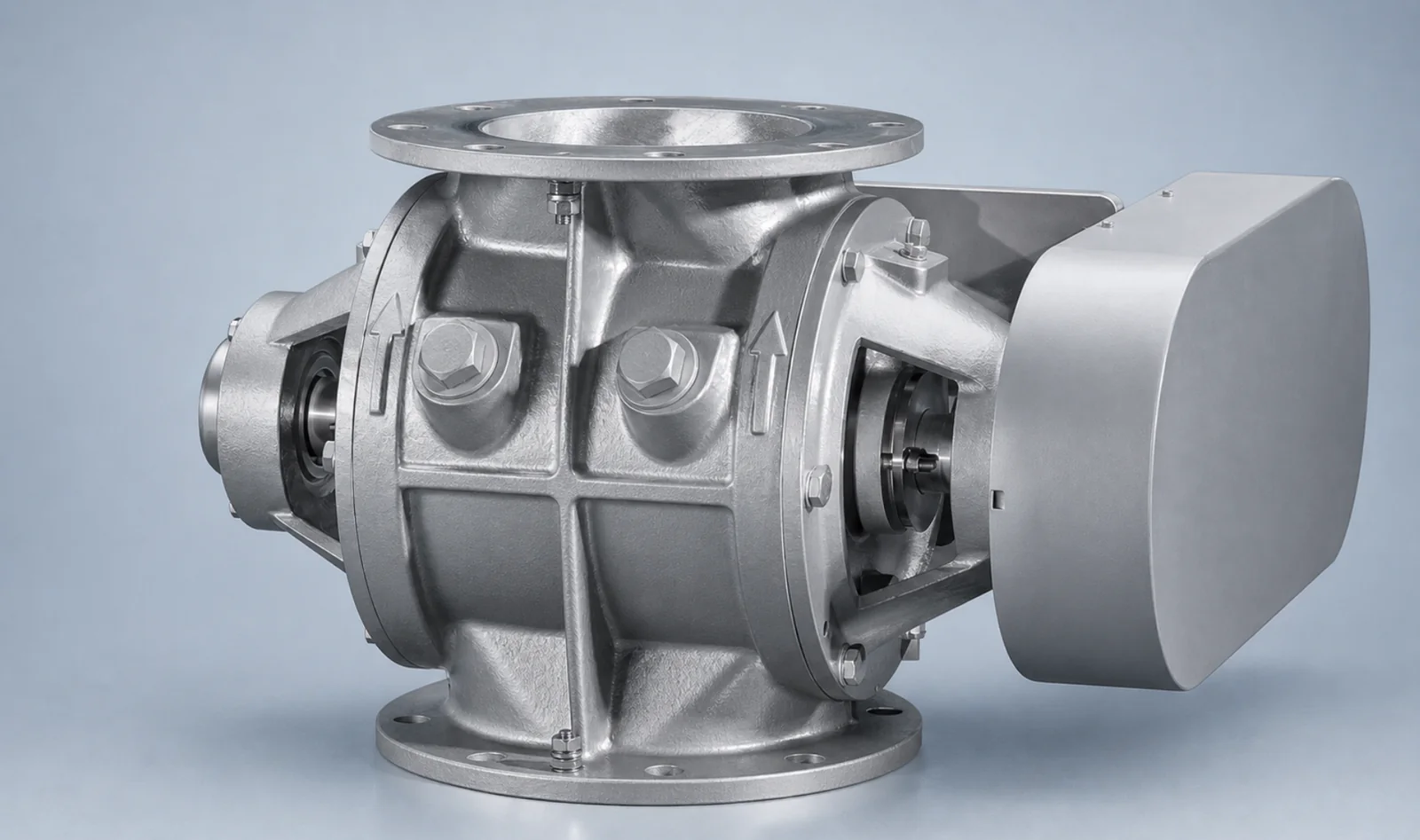
Rotary Feeder from Sercan Machinery
A rotary feeder is selected for controlled volumetric discharge from a hopper, silo or other upstream equipment. Required mass throughput must be considered together with bulk density, pocket filling and operating speed; speed alone does not establish an accurate mass flow.
Typical configuration scope
- Rotor volume selected for capacity target
- Drive speed matched to flow requirements
- Configurable inlet and outlet connections
- Compact installation layout
Common applications
- Hopper discharge
- Mixer outlet feeding
- Dust collector discharge
- Powder and granule metering
Material options
- Carbon steel
- Stainless steel contact parts
- Full stainless steel
- Coated surfaces for special materials
CHECK THE VOLUMETRIC DUTY
How to estimate rotary feeder capacity
For a rotor displacement stated in litres per revolution:
Estimated capacity (kg/h) = displacement (L/rev) × speed (rpm) × 60 × filling fraction × loose bulk density (kg/m³) ÷ 1000.
Example only: 2.5 L/rev × 20 rpm × 60 × 0.75 × 650 kg/m³ ÷ 1000 = 1,462.5 kg/h. These are illustrative assumptions, not the specification or guaranteed output of a Sercan model. A filling value of 75% is entered as 0.75.
Use the interactive capacity calculator with your own data. Confirm whether a supplier's displacement or quoted output already includes a filling allowance before applying another factor.
Capacity is not dosing accuracy
A volumetric feeder does not measure discharged mass. Changes in loose bulk density, pocket filling or upstream supply can change output. If the process needs a stated mass-flow tolerance, specify the tolerance, measurement method and time interval, and request review of the weighing and control scope.
Review normal operation and the limits
- State minimum, normal and maximum throughput, not only the peak target.
- Identify bridging, lumps, irregular hopper supply or downstream restrictions.
- Confirm pressure differential if the duty also requires an airlock.
- Check inlet/outlet bolt patterns, drive space and maintenance access with the dimension checklist.
Copy this feeder enquiry checklist
Material / particle size:
Loose bulk density (kg/m³):
Minimum / normal / maximum output (kg/h):
Continuous or intermittent operation:
Inlet / outlet pressure and temperature:
Opening size / flange drawing reference:
Motor supply / required control interface:
Mass-flow tolerance or weighing requirement:
Unknown items needing confirmation:
Request a feeder capacity review
Paste the checklist into Requirement / notes. Use the selection guide to review the remaining decisions before approving a configuration.
PROJECT-SPECIFIC SELECTION
Specify the feeding duty and its limits
Information for a feeder enquiry
- Target and operating range of throughput, including the units used.
- Loose bulk density, particle-size range, moisture and flow behavior.
- Continuous or intermittent duty, starting conditions and expected upstream material head.
- Temperature, pressure differential, inlet/outlet dimensions and motor supply.
- Any required weighing feedback or control interface, to be reviewed as part of the project scope.
Volume is not the same as measured mass
A capacity estimate depends on rotor displacement, speed, effective pocket filling and bulk density. Changing material properties can change the mass output. Use the calculator as a planning estimate, not as a guarantee of dosing accuracy.
Check material supply and discharge
Describe bridging, irregular hopper discharge, trapped lumps or downstream restrictions. These conditions may affect feeding and cannot be diagnosed from the nominal valve size alone. Include the hopper and downstream arrangement in the layout.
If pressure isolation is a central requirement, also review the rotary airlock valve duty. For direct feeding into a conveying line, compare the blow-through arrangement.
Prepare your project data
Use the capacity calculator for an initial estimate, the dimension checklist for interfaces, and the selection guide to compare requirements.
PROJECT FAQ
Questions about Rotary Feeder
Does a rotary feeder guarantee a fixed mass flow?
No. It discharges by volume; mass output also depends on bulk density and effective pocket filling. State any accuracy or weighing requirements for project review.
What should I provide for variable feed rates?
Provide the minimum, normal and maximum throughput, material properties, operating cycle and required control interface. Drive and control scope must be confirmed for the application.
Can increasing speed always increase usable capacity?
No. Pocket filling and material behavior can limit the useful output. Review the complete operating duty instead of choosing speed alone.